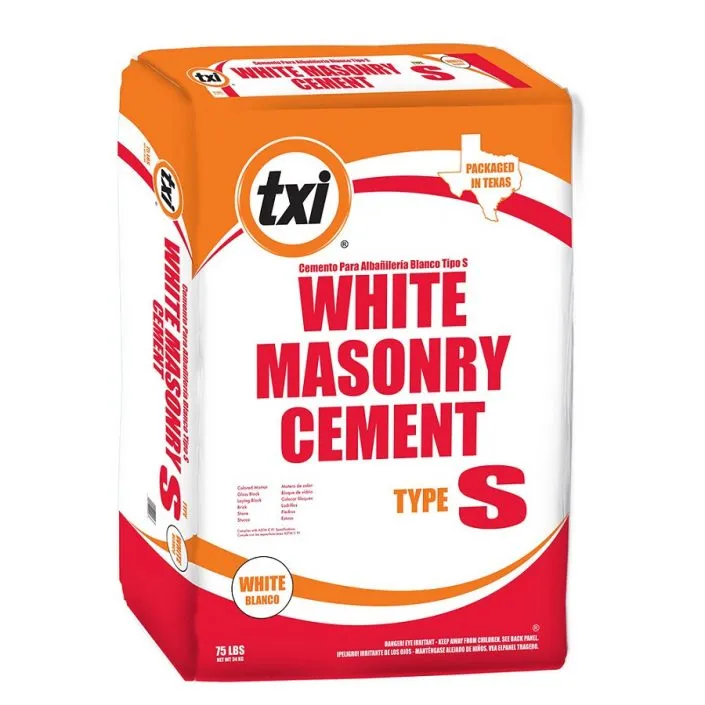

About TXI Type S White Masonry Cement
TXI Type S White Masonry Cement is a white masonry cement used to produce Type S mortar for brick, block, natural stone, architectural masonry, and other masonry applications where a lighter mortar color is desired.
Outdoor Warehouse Supply carries this product in 75 lb. bags.
Unlike TXI’s pre-blended Type S White Mortar Mix, this product is not a complete mortar mix by itself.
To make mortar, installers must add:
- Masonry sand
- Clean water
The masonry cement provides the cementitious binder and workability components needed for the mortar.
| Product Details | Specifications |
|---|---|
| Product Name | TXI Type S White Masonry Cement |
| Brand | TXI |
| Product Type | Masonry Cement |
| Mortar Classification | Used to produce Type S mortar |
| Color | White |
| Bag Size | 75 Lb. |
| Sand Included | No |
| Water Included | No |
| Primary Uses | Brick, block, natural stone, masonry walls and architectural masonry |
| Service Area | Dallas–Fort Worth and North Texas |
Current retailer listings identify TXI Type S White Masonry Cement specifically in a 75 lb. bag.
What Is Masonry Cement?
Masonry cement is a specially formulated cementitious binder designed primarily for making mortar.
It differs from straight Portland Cement because masonry cement is formulated to improve properties that are especially important to masons, such as:
- Workability
- Water retention
- Plasticity
- Bonding characteristics
- Ease of tooling
Comparable TXI masonry-cement technical documentation describes its masonry cement as a blend of Portland cement, limestone, plasticizers, air-entraining agents, and other modifiers formulated to produce a high-performance mortar component.
What Does Type S Mean?
Type S refers to a mortar classification commonly used when greater strength and bond performance are needed.
Type S mortar is commonly selected for applications such as:
- Exterior masonry
- Load-bearing walls
- Below-grade masonry
- Foundations
- Retaining-wall masonry
- Brick
- Block
- Natural stone
The exact mortar type should always follow the project’s plans, code requirements, or masonry specifications.
Does TXI Type S Masonry Cement Meet ASTM C91?
Comparable TXI Type S masonry-cement technical documentation identifies Type S masonry cement as complying with ASTM C91.
ASTM C91 is the standard specification governing masonry cement.
For specification-controlled work, contractors should still verify the current bag, technical data sheet, and project requirements for the exact white product supplied.
Is Masonry Cement the Same as Mortar?
No.
Masonry cement is an ingredient used to make mortar.
Mortar is the completed mixture.
A typical masonry-cement mortar includes:
- Masonry cement
- Masonry sand
- Water
The sand and water must still be added to this product.
TXI Masonry Cement vs. TXI Premixed Mortar
This is the most important distinction for customers.
| TXI Type S White Masonry Cement | TXI Type S White Mortar Mix |
|---|---|
| Cementitious binder | Complete premixed mortar |
| 75 lb. bag | 50 lb. bag |
| Requires masonry sand | Sand already included |
| Requires water | Requires water |
| Allows jobsite sand selection | Factory sand blend |
| Better for larger/custom mixing | Extremely convenient for smaller jobs |
For the Mortar Mix, customers just add water.
For this Masonry Cement, customers must add sand and water.
How Much Sand Is Added to Type S Masonry Cement?
Comparable TXI Type S masonry-cement documentation recommends approximately 2¼ to 3 parts masonry sand by volume for each bag of masonry cement, using sand meeting ASTM C144 and enough clean water to achieve the desired consistency.
Because formulations and current recommendations can change, installers should always follow the instructions printed on the current bag.
What Kind of Sand Should Be Used?
A clean, properly graded masonry sand should be used.
For OWS customers, Mason Sand is the appropriate category of material for typical masonry-mortar production.
Suitable sand helps provide:
- Workability
- Consistent joint texture
- Proper aggregate distribution
- Better finishing characteristics
Specification-controlled work should follow the required sand standard.
Why Does Sand Matter So Much?
Sand makes up a large portion of mortar.
Its:
- Color
- Particle size
- Gradation
- Cleanliness
- Moisture
can affect both performance and appearance.
This becomes especially important with white mortar.
A dark tan or gray sand can noticeably change the final color even when white masonry cement is used.
White Masonry Cement for Natural Stone
White masonry cement is especially popular for natural-stone installations where gray mortar would create too much visual contrast.
It pairs particularly well with:
- Austin White Limestone
- Lueders Powder Grey
- Light limestone
- Cream-colored chop stone
- Buff stone
- White marble
- Light architectural stone
A light mortar joint can create a more cohesive appearance around pale stone.
White Masonry Cement for Brick
White mortar can be used with both light and dark brick.
With Light Brick
It can create:
- Softer transitions
- More uniform appearance
- Bright architectural finishes
With Dark Brick
It can create:
- Strong contrast
- More visible joint patterns
- Traditional architectural effects
Mortar color is an important design choice because joints make up a significant visible portion of brick masonry.
White Masonry Cement for Concrete Block
TXI Type S White Masonry Cement may be used to produce mortar for concrete masonry units where Type S mortar is appropriate.
White mortar may be especially useful with:
- Architectural CMU
- Decorative block
- Exposed block walls
- Specialty masonry
Can It Be Used Above Grade?
Yes.
Type S mortar is commonly used in many above-grade masonry applications.
Examples include:
- Exterior walls
- Columns
- Stone walls
- Brick masonry
- Architectural masonry
The project’s required mortar type should still control.
Can It Be Used Below Grade?
Type S mortar is also commonly selected for below-grade masonry applications because of its relatively higher strength and bond characteristics.
Comparable TXI documentation recommends Type S mortar for exterior masonry at or below grade.
Proper drainage, waterproofing, reinforcement, and structural design remain separate requirements.
Is Type S Mortar Good for Retaining Walls?
Type S mortar may be used in properly designed masonry retaining-wall systems.
However, mortar alone does not make a retaining wall structurally adequate.
A retaining wall may require:
- Reinforced footings
- Drainage
- Reinforcement
- Grouted cells
- Engineering
- Appropriate block or stone
Always follow the design requirements.
Is Type S Mortar Good for Natural Stone Walls?
Yes, where Type S mortar is appropriate for the design.
Its strength and bond characteristics make it common in many stone-masonry applications.
White masonry cement is particularly attractive when working with lighter natural stone.
Why Choose White Masonry Cement?
The biggest advantage is appearance.
White masonry cement allows masons to create mortar ranging from:
- Bright white
- Cream
- Buff
- Light tan
- Pastel colors
depending on the sand and pigments used.
That makes it useful for architectural masonry where the mortar joint is an intentional design element.
Can TXI White Masonry Cement Be Pigmented?
Yes, compatible masonry pigments can be used to produce custom-colored mortar.
Starting with a white cementitious base can make it easier to create:
- Light tan
- Cream
- Buff
- Soft gray
- Pastel
- Custom architectural colors
Follow pigment-manufacturer recommendations carefully.
Why Is White Cement Better for Light Mortar Colors?
Gray cement can darken or muddy light pigments.
White masonry cement provides a lighter starting base, allowing color pigments to appear cleaner and more predictable.
This is particularly useful for matching:
- Limestone
- Brick
- Architectural stone
- Existing mortar
Does Sand Color Affect White Mortar?
Yes—significantly.
White masonry cement does not guarantee bright-white mortar.
If the sand is:
- Tan
- Brown
- Gray
- Gold
those colors will influence the finished mortar.
For appearance-sensitive projects, make a sample panel before beginning large-scale work.
Should a Mortar Mock-Up Be Made?
Yes, especially when color matters.
TXI’s technical guidance for masonry cement recommends constructing mock-ups using the actual mortar components when color approval is important because sand selection affects final appearance.
A mock-up helps evaluate:
- Finished color
- Joint profile
- Sand appearance
- Tooling
- Texture
before an entire wall is installed.
How Is TXI Type S Masonry Cement Mixed?
A typical process is:
- Place part of the required clean water into the mixer.
- Add masonry cement.
- Add properly proportioned Mason Sand.
- Add remaining water gradually.
- Mix until a smooth, workable consistency is achieved.
Comparable TXI technical guidance recommends mechanical mixing where possible and mixing for at least approximately five minutes. Follow the current bag instructions.
Should You Add Extra Portland Cement?
Not unless the mortar design specifically requires it.
Masonry cement is already formulated to produce a particular mortar classification when mixed according to its instructions.
Adding extra Portland Cement changes the mix proportions and can affect:
- Workability
- Strength
- Bond
- Shrinkage
- Color
Should You Add Lime?
Normally, no additional lime should be added unless a specified mortar design calls for it.
Masonry cement is formulated to provide the plasticity and workability required for masonry applications.
Adding unplanned ingredients changes the designed mixture.
Can Admixtures Be Added?
Only when compatible and permitted by the project specifications.
Comparable TXI technical documentation states that admixtures should not be used without approval from the architect or owner on specification-controlled projects.
Does More Cement Make Mortar Stronger?
Not automatically, and stronger is not always better.
Mortar must balance:
- Strength
- Bond
- Flexibility
- Workability
- Water retention
An excessively hard mortar can be inappropriate for certain masonry units.
Always use the mortar type specified for the application.
Is Type S Stronger Than Type N?
Generally, Type S mortar has higher compressive-strength requirements than Type N mortar.
That does not mean Type S should automatically be chosen for every project.
Type N may be more appropriate for many:
- Above-grade walls
- Veneers
- Interior applications
- Certain natural-stone applications
The correct mortar depends on the masonry system.
Type S vs. Type N Mortar
| Type S | Type N |
|---|---|
| Higher strength | Moderate strength |
| Stronger bond | More general-purpose |
| Common below grade | Common above grade |
| Often used in structural masonry | Often used in veneers |
| Less flexible than Type N | More forgiving for some masonry |
Project requirements should determine which type is used.
TXI Type S White Masonry Cement vs. White Portland Cement
| White Masonry Cement | White Portland Cement |
|---|---|
| Specifically formulated for mortar | General hydraulic cement |
| Improved workability | Requires full mortar formulation |
| Add Mason Sand + water | Usually requires sand and potentially lime/additives |
| Designed for masonry | Used in concrete, mortar, stucco and precast |
| Easier mortar production | Greater formulation flexibility |
For standard masonry mortar, masonry cement is typically the simpler route.
TXI Type S White Masonry Cement vs. Gray Masonry Cement
| White Masonry Cement | Gray Masonry Cement |
|---|---|
| White cementitious base | Gray base |
| Better for light masonry | Traditional appearance |
| Excellent for pigments | Better for conventional gray joints |
| Architectural appearance | General-purpose appearance |
The required mortar classification may be the same while the finished appearance changes dramatically.
How Much Mortar Does a 75 Lb. Bag Make?
The exact mortar yield depends on:
- Sand proportion
- Sand moisture
- Water
- Joint dimensions
- Mixing method
- Waste
For that reason, the safest sales recommendation is to estimate coverage based on the actual masonry unit and mortar-joint dimensions rather than advertise one universal coverage number.
Does Mortar Need to Cure?
Yes.
Mortar develops strength through cement hydration.
Proper curing and protection help support:
- Bond
- Strength
- Durability
- Color consistency
Fresh mortar should be protected from extreme drying, freezing, and severe weather.
Can White Masonry Cement Be Used in North Texas Heat?
Yes, but Dallas–Fort Worth summer conditions can accelerate:
- Water evaporation
- Mortar stiffening
- Surface drying
Hot-weather masonry may require:
- Smaller batches
- Shaded materials
- Appropriate water management
- Proper curing
Avoid simply adding excessive water to compensate for hot weather.
How Should Masonry Cement Be Stored?
Keep bags:
- Dry
- Off wet soil or concrete
- Under weather-tight cover
- Protected from rain
- Protected from humidity
- In intact packaging
Once moisture begins hydrating the cementitious ingredients, the product can lose performance.
Can Hardened Masonry Cement Be Used?
Significant hard lumps can indicate moisture exposure and partial hydration.
Compromised material should not be relied upon for structural or quality-sensitive masonry work.
Safety When Handling Masonry Cement
Masonry cement is alkaline.
Dry dust may irritate:
- Eyes
- Skin
- Respiratory passages
Wet mortar can cause chemical burns with prolonged skin exposure.
Use appropriate:
- Gloves
- Eye protection
- Long sleeves
- Work boots
- Dust protection where needed
Always follow the current Safety Data Sheet.
Pros & Cons of TXI Type S White Masonry Cement
| Pros | Cons |
|---|---|
| Produces white Type S mortar | Mason Sand must be added |
| Excellent for light-colored stone | More mixing required than premixed mortar |
| 75 lb. contractor-friendly bag | Sand color affects finished mortar |
| Allows custom mortar colors | Water and sand proportions must remain consistent |
| Good for brick, block and stone | Type S is not appropriate for every masonry project |
| Useful above and below grade where specified | Requires proper dry storage |
| Allows contractors to select their own sand | More opportunity for batch variation |
| Good for larger masonry jobs | Cementitious dust requires safe handling |
TXI Type S White Masonry Cement in Dallas–Fort Worth
TXI Type S White Masonry Cement is an excellent option for Dallas–Fort Worth masons and contractors who want to produce Type S mortar with a clean white or light-colored appearance.
It is especially useful for:
- Limestone masonry
- Chop-stone walls
- Brick
- Concrete block
- Architectural masonry
- Custom-colored mortar
Outdoor Warehouse Supply carries TXI Type S White Masonry Cement in 75 lb. bags through our Plano and Lewisville locations. Current listings confirm the TXI 75 lb. white Type S masonry-cement package.
Industry Contractor & Wholesale Pricing
Outdoor Warehouse Supply offers industry contractor and wholesale pricing for qualifying masons, masonry contractors, landscape contractors, builders, hardscape installers, commercial contractors, and other industry buyers.
Contractors can source TXI Type S White Masonry Cement alongside Mason Sand, White Portland Cement, premixed Type S Mortar, chop stone, flagstone, building stone, and other masonry materials throughout Dallas–Fort Worth and North Texas.
Contact our Plano or Lewisville sales staff for current inventory and pallet quantities.
Frequently Asked Questions
What is TXI Type S White Masonry Cement?
It is a white masonry cement designed to be mixed with masonry sand and water to produce Type S mortar.
What size bag does OWS carry?
Outdoor Warehouse Supply carries it in a 75 lb. bag. Current TXI listings confirm this package size.
Is this a premixed mortar?
No.
This is masonry cement, not complete mortar.
Do I need to add sand?
Yes.
Masonry sand must be added.
Do I only add water?
No.
That applies to TXI’s pre-blended mortar mix. This masonry cement requires both sand and water.
What kind of sand should I use?
Use clean, properly graded Mason Sand appropriate for masonry mortar.
How much sand should be added?
Comparable TXI Type S masonry-cement guidance calls for approximately 2¼–3 parts masonry sand by volume per bag of cement, but the current bag instructions should always be followed.
Does TXI Type S Masonry Cement meet ASTM C91?
Comparable TXI Type S masonry-cement technical documentation identifies the product class as meeting ASTM C91.
Can it be used to make Type S mortar?
Yes.
That is its intended purpose.
Can TXI Type S White Masonry Cement be used with natural stone?
Yes, where Type S mortar is appropriate.
Is it good for limestone?
Yes.
The white cement base pairs particularly well with light-colored limestone.
Can it be used for brick?
Yes.
Can it be used for concrete block?
Yes.
Can Type S mortar be used below grade?
Yes, where the design calls for Type S mortar. Comparable TXI guidance recommends Type S for exterior at- or below-grade masonry.
Can Type S mortar be used above grade?
Yes.
Can it be used for retaining walls?
Yes, as part of an appropriately designed masonry retaining-wall system.
Is Type S stronger than Type N?
Generally yes in compressive-strength classification, but Type S is not automatically the better choice for every masonry application.
Why use white masonry cement?
It allows contractors to create white, cream, buff, pastel, and other light architectural mortar colors.
Does sand color affect the mortar?
Yes.
Sand can significantly influence the finished mortar color.
Should I make a sample before starting?
Yes, particularly for appearance-sensitive masonry. TXI technical guidance recommends mock-ups when sand selection and final color matter.
Can TXI White Masonry Cement be pigmented?
Yes, compatible masonry pigments can be used according to manufacturer and project requirements.
Do I need to add lime?
Normally not unless the specified mortar formulation requires it.
Should I add Portland Cement?
Not unless the specified mix design calls for it.
Is TXI Masonry Cement the same as White Portland Cement?
No.
Masonry cement is specifically formulated for mortar workability, while White Portland Cement is a more general hydraulic cement.
Is TXI Masonry Cement the same as TXI White Mortar Mix?
No.
The mortar mix already contains sand. Masonry cement does not.
How much mortar does one 75 lb. bag make?
Yield depends on sand proportion, joint dimensions, masonry unit, and jobsite waste, so there is no single reliable coverage number for every project.
Does Type S mortar need to cure?
Yes.
Mortar develops strength through cement hydration.
Can it be used during hot North Texas weather?
Yes, with appropriate hot-weather masonry procedures.
How should TXI Masonry Cement be stored?
Keep the bags completely dry, protected from humidity and rain, and stored off wet ground.
Is TXI Type S White Masonry Cement available in Dallas–Fort Worth?
Yes.
Outdoor Warehouse Supply carries it through our Plano and Lewisville locations.