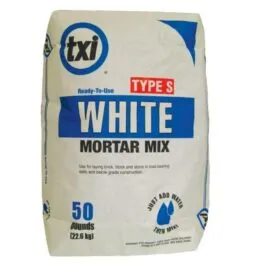


About Amerimix Type S Gray Mortar Mix
Amerimix Type S Gray Mortar Mix is a factory pre-blended masonry mortar designed for laying and resetting brick, block, and stone in applications where Type S mortar is appropriate.
Because it is pre-blended, the dry ingredients are already proportioned at the factory.
The installer primarily needs to:
- Add clean water
- Mix thoroughly
- Adjust only as permitted by the manufacturer’s instructions
- Place and tool the mortar properly
This eliminates the need to separately measure masonry cement and masonry sand on the jobsite.
| Product Details | Specifications |
|---|---|
| Product Name | Amerimix Type S Gray Mortar Mix |
| Brand | Amerimix |
| Product Series | AMX 500 Series |
| Product Type | Pre-Blended Masonry Mortar |
| Mortar Type | Type S |
| Color | Gray |
| Bag Size | 80 Lb. |
| Sand Included | Yes |
| Primary Mixing Requirement | Add water |
| 28-Day Type S Requirement | 1,800 PSI minimum |
| ASTM Standard | Designed to meet ASTM C270 |
| Primary Uses | Brick, block, stone, tuckpointing, masonry construction |
| Applications | Interior/exterior; above and below grade where Type S is appropriate |
| Service Area | Dallas–Fort Worth and North Texas |
Amerimix also identifies its pre-blended mortar systems as designed to meet ASTM C1714 when pre-blended dry mortar is specified.
What Is Amerimix Type S Mortar Mix?
Amerimix Type S Mortar Mix is a complete dry masonry mortar blend.
Unlike straight masonry cement, it already contains the dry materials needed to create mortar.
That means customers do not need to separately purchase and proportion:
- Masonry cement
- Mason Sand
The factory blend helps improve consistency from batch to batch.
Amerimix specifically promotes pre-blended mortar as a way to reduce variability, labor, waste, and jobsite mixing inconsistencies.
What Does Type S Mortar Mean?
Type S is a masonry mortar classification commonly used where higher compressive strength and stronger bond performance are needed.
Amerimix describes Type S as having a 1,800 PSI compressive-strength requirement and identifies it for applications including:
- Above-grade masonry
- Below-grade masonry
- Patios
- Retaining walls
- Masonry foundations
- Sewers. Amerimix
Type S is stronger than Type N, but that does not mean it should automatically be used for every masonry project.
Why Use Pre-Blended Mortar?
Factory pre-blended mortar offers several practical advantages.
Consistent Proportions
The dry ingredients are measured under controlled manufacturing conditions instead of being estimated at the jobsite.
Less Jobsite Labor
The installer does not have to separately measure cement and sand.
Faster Mixing
The primary jobsite step is adding water and mixing.
Reduced Waste
Amerimix specifically markets its pre-blended system around reduced waste and cleaner jobsites.
More Consistent Performance
Consistent dry ingredients can help improve repeatability across multiple batches.
Just Add Water
One of the biggest benefits of Amerimix Type S Gray Mortar Mix is convenience.
The masonry cement and sand are already blended.
The installer adds the amount of clean water required by the current bag instructions and mixes until the proper mortar consistency is achieved.
Avoid making mortar excessively wet just to improve spreadability.
Too much water can negatively affect:
- Strength
- Shrinkage
- Joint appearance
- Bond
- Finished durability
Does Amerimix Type S Mortar Already Contain Sand?
Yes.
Amerimix identifies the AMX 500 Series as Masonry Cement & Sand Mortar Mix.
That means customers should not normally add additional masonry sand.
Adding extra sand would change the factory-designed proportions.
What Is the Compressive Strength?
Amerimix lists the ASTM C270 minimum 28-day compressive strength for Type S mortar as:
1,800 PSI
and reports AMX 500 Type S results as greater than 1,800 PSI under the referenced laboratory test conditions.
It is important to understand that this laboratory mortar strength is not the same thing as saying the completed masonry wall itself is “1,800 PSI.”
Amerimix also notes that ASTM C270 laboratory results and field mortar testing under ASTM C780 are not directly interchangeable.
Does Amerimix Type S Meet ASTM C270?
Yes.
Amerimix states that the AMX 500 Series is designed to meet ASTM C270 Standard Specification for Mortar for Unit Masonry.
For engineered or specification-controlled projects, always verify the current technical data sheet and project requirements.
Amerimix Type S Mortar for Brick
Amerimix specifically lists laying or resetting brick among the intended applications for AMX 500 mortar.
Gray Type S mortar works well with:
- Red brick
- Brown brick
- Gray brick
- Dark brick
- Commercial masonry
The gray joint creates a traditional masonry appearance.
Amerimix Type S Mortar for Concrete Block
Type S mortar is commonly used with CMU where the project requires its strength and bond characteristics.
Applications may include:
- Block walls
- Foundations
- Commercial masonry
- Retaining-wall systems
- Utility structures
Amerimix specifically identifies block among the approved uses for its AMX 500 mortar.
Amerimix Type S Mortar for Natural Stone
Amerimix also lists stone installation among the intended uses.
Gray mortar can work particularly well with:
- Oklahoma Brown stone
- Oklahoma Blue / Silvermist
- Charcoal stone
- Dark limestone
- Mixed-color building stone
For very light architectural limestone, a white mortar may provide a softer appearance.
Amerimix Type S Mortar for Tuckpointing
Amerimix lists brick and block tuckpointing among the applications for the AMX 500 Series.
However, Type S is not appropriate for every older or historic masonry wall.
Older masonry units may require a softer mortar.
The replacement mortar should be compatible with the existing masonry rather than selected solely because Type S is stronger.
Can Amerimix Type S Be Used Above Grade?
Yes.
Amerimix lists above-grade use for its Type S mortar.
Common examples include:
- Brick walls
- Block walls
- Columns
- Stone masonry
- Exterior masonry
Can Amerimix Type S Be Used Below Grade?
Yes.
Amerimix also lists Type S for below-grade applications.
Potential examples include:
- Foundations
- Below-grade block
- Retaining-wall masonry
- Other compatible structural masonry
Proper waterproofing, drainage, reinforcement, and structural design remain separate project requirements.
Amerimix Type S Mortar for Retaining Walls
Amerimix specifically identifies retaining walls as one of the common Type S applications.
However, mortar does not make a retaining wall structurally adequate by itself.
A proper masonry retaining wall may also require:
- Footings
- Drainage
- Reinforcement
- Grouted cells
- Engineering
- Proper masonry units
Amerimix Type S Mortar for Foundations
Amerimix identifies masonry foundations among typical Type S uses.
The complete foundation design must still comply with applicable structural requirements.
Amerimix Type S Mortar vs. Type N Mortar
| Type S Mortar | Type N Mortar |
|---|---|
| Higher compressive strength | Moderate compressive strength |
| 1,800 PSI minimum under ASTM C270 property specification | 750 PSI minimum under ASTM C270 property specification |
| Common above and below grade | Common primarily above grade |
| Often selected for stronger structural applications | Common for veneers and general masonry |
| Stronger bond characteristics | More forgiving in many standard applications |
Amerimix lists those ASTM C270 property-strength requirements in its current AMX 500 technical data.
Amerimix Type S Mortar vs. Type M Mortar
| Type S | Type M |
|---|---|
| 1,800 PSI minimum | 2,500 PSI minimum |
| Strong general-purpose structural mortar | Higher-strength mortar |
| Common for foundations and retaining walls | Used for heavier-duty masonry |
| More versatile for many projects | Selected where higher strength is required |
Stronger does not automatically mean better.
The masonry units and project design should determine the correct mortar.
Amerimix Type S Mortar vs. Masonry Cement
| Amerimix Type S Mortar Mix | Masonry Cement |
|---|---|
| Complete dry mortar | Cementitious binder |
| Sand already included | Sand must be added |
| Add water | Add sand + water |
| Factory proportioned | Jobsite proportioning |
| Convenient and consistent | More control over sand selection |
This is an important customer distinction.
Amerimix Type S Mortar vs. Portland Cement
Portland Cement is a basic hydraulic binder.
Amerimix Type S Mortar Mix is already formulated as a complete masonry mortar system.
| Amerimix Mortar Mix | Portland Cement |
|---|---|
| Ready-to-mix mortar | Cement ingredient |
| Sand included | Sand not included |
| Designed for masonry joints | Used in concrete, mortar, grout and more |
| Add water | Requires additional ingredients |
Amerimix Type S Mortar vs. Concrete Mix
Mortar and concrete are not interchangeable.
| Mortar Mix | Concrete Mix |
|---|---|
| Designed to bond masonry units | Designed to form slabs and structural concrete |
| Fine aggregate | Includes coarse aggregate |
| Used for brick, block and stone | Used for slabs, footings and posts |
| Workable joint material | Structural composite material |
Do not use concrete mix as a substitute for masonry mortar.
Does Amerimix Type S Mortar Need Lime Added?
No, not under normal use.
The mortar is already factory formulated.
Adding lime would change the designed proportions and performance.
Only modify the mix if the manufacturer or project specification specifically permits it.
Should Extra Sand Be Added?
Normally no.
Because Amerimix Type S is already a pre-blended cement-and-sand mortar, adding extra sand changes the formulation.
Should Extra Portland Cement Be Added?
Normally no.
Adding extra cement can alter:
- Strength
- Workability
- Shrinkage
- Bond
- Joint behavior
Use the product as designed unless the project specification says otherwise.
Can Amerimix Type S Mortar Be Pigmented?
Amerimix states that AMX 500 mortar may be pigmented.
However, because the base mortar is gray, pigments will be influenced by the existing gray color.
Gray mortar works especially well as a base for darker colors such as:
- Charcoal
- Brown
- Dark gray
- Earth tones
For light architectural colors, white mortar is usually a better starting point.
Does Water Amount Affect Mortar Color?
Yes.
Variations in water content can affect:
- Joint texture
- Drying
- Curing
- Surface appearance
Keeping water quantities consistent can help produce more uniform exposed joints.
How Is Amerimix Type S Mortar Mixed?
A typical mixing process is:
- Add most of the required clean water to the mixer.
- Add the Amerimix dry mortar.
- Mix thoroughly.
- Add small amounts of water only as needed.
- Continue mixing until a uniform workable consistency is achieved.
Always follow the current Amerimix bag instructions.
Should Amerimix Mortar Be Mechanically Mixed?
Mechanical mixing is preferred for many contractor applications because it improves batch consistency.
Consistent mixing time helps produce more uniform:
- Workability
- Water distribution
- Joint appearance
What Temperature Is Best for Installation?
Amerimix lists an optimal mortar application range of approximately 40°F to 90°F.
Installation outside that range may still be possible when proper hot- or cold-weather masonry procedures are followed.
Can Amerimix Type S Be Used in Hot North Texas Weather?
Yes, but North Texas summer conditions can create challenges.
High temperatures, sunlight, wind, and dry air can accelerate:
- Water loss
- Mortar stiffening
- Surface drying
Hot-weather masonry may require:
- Smaller batches
- Shading materials
- Protecting masonry units
- Careful water control
- Appropriate curing
Amerimix notes that very dry, windy, porous, or high-temperature conditions may require additional substrate preparation such as saturated-surface-dry conditioning when appropriate.
Can Amerimix Type S Be Used in Cold Weather?
Yes, with appropriate cold-weather masonry procedures.
Temperatures below Amerimix’s preferred 40°F range require additional precautions.
Fresh mortar must be protected from freezing.
How Much Does One 80 Lb. Bag Yield?
Amerimix’s published data lists approximately:
0.78 cubic feet of mortar per 80 lb. bag.
Actual yield can vary slightly with:
- Water content
- Installation technique
- Waste
- Joint dimensions
How Much Can One Bag Lay?
Amerimix publishes approximate coverage for an 80 lb. bag at approximately:
- 12 concrete blocks
- 36 standard bricks
- 17 sq. ft. of manufactured stone
based on approximately 3/8″ mortar joints.
These are estimating figures rather than guaranteed coverage.
Natural stone coverage can vary considerably because stone size and joint dimensions are less uniform.
Why Does Mortar Coverage Vary?
Coverage depends on:
- Masonry-unit dimensions
- Joint width
- Joint depth
- Stone shape
- Installation technique
- Waste
- Joint profile
Irregular natural stone can require significantly more mortar than uniform brick.
Does Amerimix Type S Mortar Need to Cure?
Yes.
Mortar gains strength through cement hydration.
Amerimix notes that mortar strength development continues through the curing period, with full design strength commonly associated with the 28-day testing age.
Fresh masonry should be protected from:
- Freezing
- Excessive drying
- Heavy rain
- Extreme heat
How Should Amerimix Mortar Be Stored?
Keep bags:
- Dry
- Off wet ground
- Protected from rain
- Protected from humidity
- In intact packaging
Cementitious materials can begin reacting once exposed to moisture.
Can Hardened Mortar Mix Be Used?
If significant hard lumps have formed because of moisture exposure, some of the cementitious material may already have hydrated.
Compromised material should not be relied upon for structural or quality-sensitive masonry.
Safety When Handling Amerimix Mortar
Mortar contains cementitious materials and sand.
Dry material can expose workers to:
- Alkaline cement dust
- Respirable dust
- Crystalline silica from sand
Wet mortar can also cause skin irritation or chemical burns with prolonged exposure.
Use appropriate:
- Gloves
- Eye protection
- Long sleeves
- Work boots
- Respiratory protection when required
Amerimix provides current SDS documentation through its technical-document library.
Pros & Cons of Amerimix Type S Gray Mortar Mix
| Pros | Cons |
|---|---|
| Complete pre-blended mortar | Heavier 80 lb. bags |
| Sand already included | More expensive than some field-mixed systems |
| Primarily just add water | Water still must be controlled carefully |
| Factory-proportioned consistency | Less flexibility than custom field mixes |
| 1,800 PSI Type S classification | Type S is not appropriate for every masonry project |
| Above- and below-grade capability where appropriate | Gray color may not suit light architectural stone |
| Good for brick, block and stone | Requires dry storage |
| Published bag yield and coverage | Natural-stone coverage varies significantly |
| Reduces jobsite sand handling | Cement and silica dust require proper PPE |
Amerimix Type S Gray Mortar Mix in Dallas–Fort Worth
Amerimix Type S Gray Mortar Mix is an excellent option for Dallas–Fort Worth masons and contractors who want a factory pre-blended Type S mortar with consistent proportions and no separate sand pile required.
It is especially useful for:
- Brick
- Concrete block
- Natural stone
- Foundations
- Retaining-wall masonry
- Tuckpointing where Type S is compatible
- General exterior masonry
Outdoor Warehouse Supply carries Amerimix Type S Gray Mortar Mix in 80 lb. bags through our Plano and Lewisville locations.
Industry Contractor & Wholesale Pricing
Outdoor Warehouse Supply offers industry contractor and wholesale pricing for qualifying masons, masonry contractors, builders, landscape contractors, hardscape installers, commercial contractors, and other industry buyers.
Contractors can source Amerimix Type S Gray Mortar Mix alongside masonry stone, chop stone, flagstone, concrete block products, Portland Cement, Mason Sand, and other construction materials throughout Dallas–Fort Worth and North Texas.
Contact our Plano or Lewisville sales staff for current quantities and pallet availability.
Frequently Asked Questions
What is Amerimix Type S Gray Mortar Mix?
It is a factory pre-blended gray Type S masonry mortar containing the dry cementitious materials and sand needed for masonry work.
What size bag is Amerimix Type S Mortar Mix?
Amerimix currently lists the AMX 500 mortar in 80 lb. bags.
Do I need to add sand?
No.
Amerimix identifies this product as a pre-blended masonry cement and sand mortar.
Do I need to add lime?
No under normal use.
The dry mortar is already factory formulated.
What do I add?
Normally, clean water according to the current bag instructions.
What is Type S mortar?
Type S is a higher-strength masonry mortar classification with an ASTM C270 property-specification minimum of 1,800 PSI at 28 days.
Does Amerimix Type S meet ASTM C270?
Yes.
Amerimix states that the AMX 500 Series is designed to meet ASTM C270.
Can Amerimix Type S be used for brick?
Yes.
Amerimix specifically lists brick as an intended application.
Can it be used for concrete block?
Yes.
Can it be used for natural stone?
Yes.
Stone is specifically included among Amerimix’s intended applications.
Can Amerimix Type S be used above grade?
Yes.
Can it be used below grade?
Yes, where Type S mortar is appropriate.
Can it be used for retaining walls?
Yes, in appropriately designed masonry retaining-wall systems. Amerimix identifies retaining walls among common Type S applications.
Can it be used for masonry foundations?
Yes.
Amerimix identifies masonry foundations among common Type S uses.
Is Type S stronger than Type N?
Yes in ASTM C270 compressive-strength classification.
Amerimix lists 1,800 PSI for Type S versus 750 PSI for Type N.
Is Type S stronger than Type M?
No.
Type M has the higher ASTM C270 compressive-strength requirement at 2,500 PSI.
Is Amerimix Mortar Mix the same as masonry cement?
No.
Masonry cement still requires field-added sand. Amerimix Mortar Mix already contains the sand.
Is Amerimix Mortar Mix the same as Portland Cement?
No.
Portland Cement is a binder ingredient, while Amerimix is a complete pre-blended masonry mortar.
Should I add extra sand?
No under normal use.
Doing so changes the factory proportions.
Should I add extra Portland Cement?
No unless a specific approved mix design requires it.
Can Amerimix Type S mortar be colored?
Amerimix states that its AMX 500 mortar may be pigmented.
How much does one 80 lb. bag yield?
Approximately 0.78 cubic feet according to Amerimix published data.
How many bricks can one bag lay?
Amerimix estimates up to approximately 36 standard bricks with 3/8″ mortar joints.
How many concrete blocks can one bag lay?
Approximately 12 concrete blocks based on Amerimix’s published estimating figures.
How much manufactured stone can one bag cover?
Amerimix estimates approximately 17 sq. ft. under its listed conditions.
What temperature is best for installing Amerimix mortar?
Amerimix lists approximately 40°F–90°F as the optimal application range.
Can it be used in hot North Texas weather?
Yes, with appropriate hot-weather masonry practices.
Does Amerimix mortar need to cure?
Yes.
Cementitious mortar develops strength through hydration.
How should Amerimix Mortar Mix be stored?
Keep the bags completely dry and protected from moisture.
Is Amerimix Type S Gray Mortar Mix available in Dallas–Fort Worth?
Yes.
Outdoor Warehouse Supply carries it through our Plano and Lewisville locations.